
Onboarding: User experience
In this section, we showcase visuals and the primary user interactions with the Onboarding Element.
See Onboarding: Implementation for implementation details, including pre-conditions, custom events, and error handling.
Core behavior and requirements
With the Onboarding Element, BILL has a set of requirements for the expected behavior.
| Behavior & requirements | Description |
|---|---|
| User role | The organization user must have the ADMINISTRATOR user role to submit business type, industry, and other required information. BILL uses this information for initiating the risk verification process for the organization. |
| MFA requirements | After organization onboarding, BILL prompts the user to complete the MFA setup. A valid phone number is required for the user to set up MFA. You can receive the MFA challenge by text message or voice call. The text message option is not supported for international phone numbers. |
| Funding payment method operations | When the user adds a bank account with Plaid, the Plaid requires the user to sign in with their bank account credentials and complete the bank account add flow. The account is automatically verified and is ready for use. When the user adds a bank account with manual setup, BILL sends a test payment to the added account. The user must verify the added bank account by entering the test payment amount. When the user adds a card account, all the card details are required for manually entering the information. |
| User verification | Before the user can use a funding payment method, the user may be required to undergo BILL risk verification. Users that are flagged by the BILL risk model are set as If user verification is required, the user is prompted to complete the verification process in the Onboarding Element. User verification is also available with the User verification Element, Add funding Element, Manage funding Element, and Schedule payment Element. Without verification, the user cannot use a funding payment method for payments. |
Plan your user experience
In this section, we outline key considerations for planning a seamless user experience when integrating with the Onboarding Element into your application. Ensure that you address each point thoughtfully to realize the full value of the Element capabilities in your existing experience.
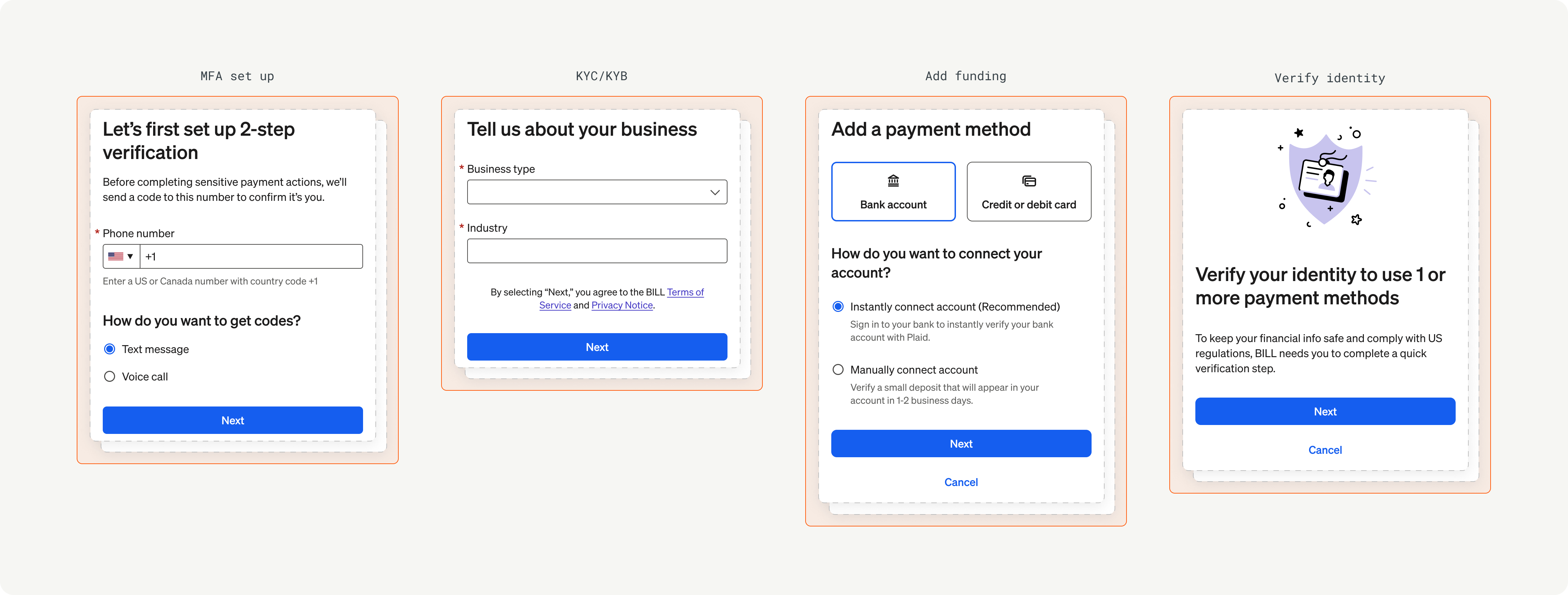
Element overview
Assumptions
When the user is using the Onboarding Element, BILL makes a set of assumptions.
| Assumptions |
|---|
| The organization and user has been set up with the BILL v3 API. See Organizations for BILL partners and Users for BILL partners for more information. |
| The organization has not been previously onboarded with BILL. |
Entry points
There are a set of workflows where the Onboarding Element can be integrated.
- On the organization enrollment landing page
- When the user is attempting to set up payments
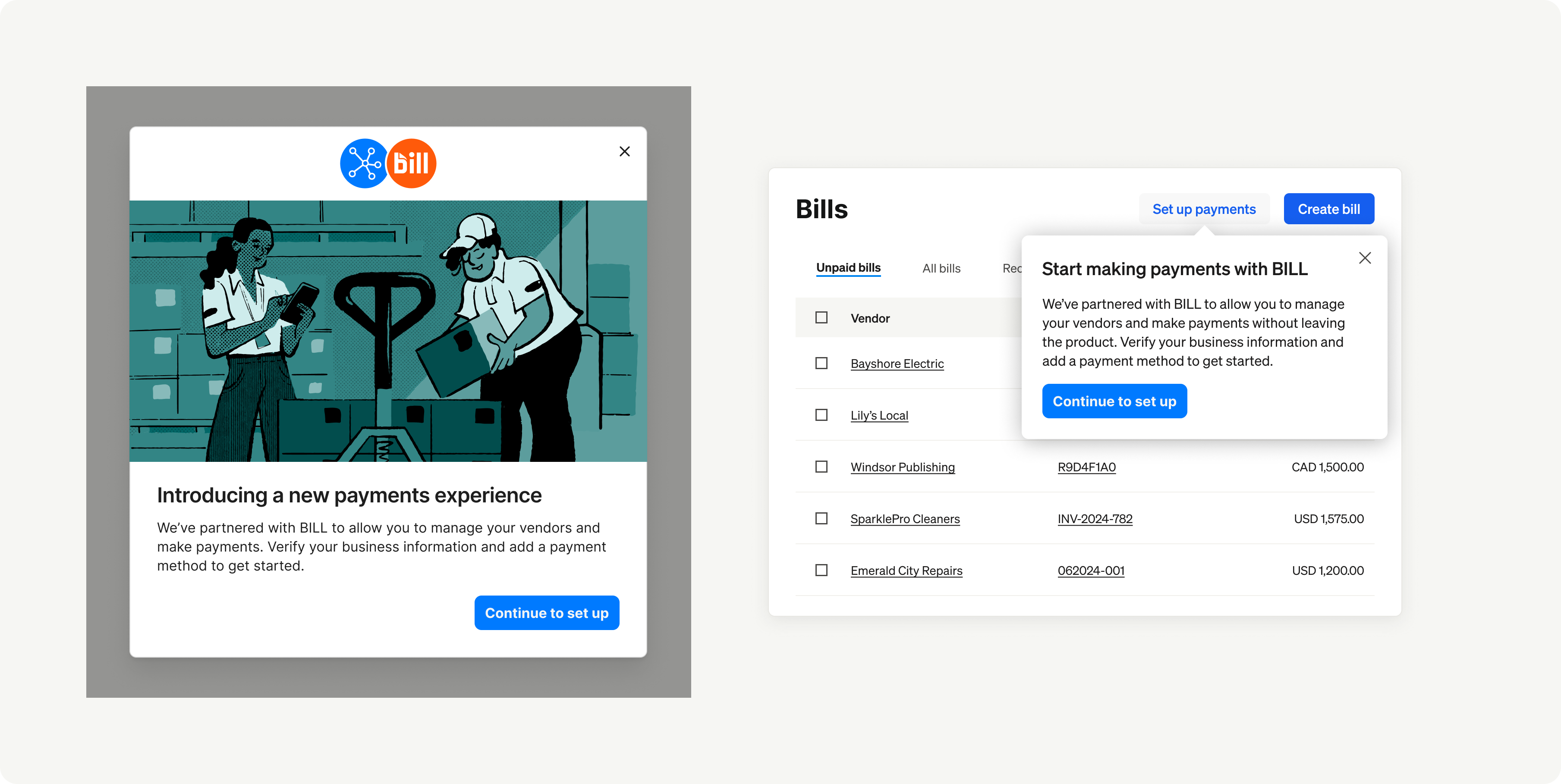
Element entry points
Map the user flow
Map the complete user flow from identifying the need to start organization onboarding to successfully completing the process of making a payment.
Maintain context
Ensure that your users understand that they are onboarding their organization with BILL. In addition, your users must understand how this relates to their ability to pay bills with your integrated experience.
Related Elements
BILL Elements are connected and understanding this connection and hierarchy enables you to understand the user experience better.
| Connection | Description |
|---|---|
| Child | MFA Element : MFA is required for the user to add a funding payment method. When the signed-in user session is not MFA-trusted, the user is required to complete the MFA setup. Add funding Element : The user can add funding payment methods in the organization. Manage funding Element : The user can add additional funding payment methods and manage existing funding method details in the organization. User verification Element : The user may be required to complete one-time BILL risk verification before the user can use a funding payment method for payments. |
Updated 8 months ago
What’s Next
Now that you understand the user experience, the next step is to integrate the Onboarding element. Continue to the Implementation section to learn about pre-conditions, custom events, and error handling.